Cargo Hub: software that tames messy logistics
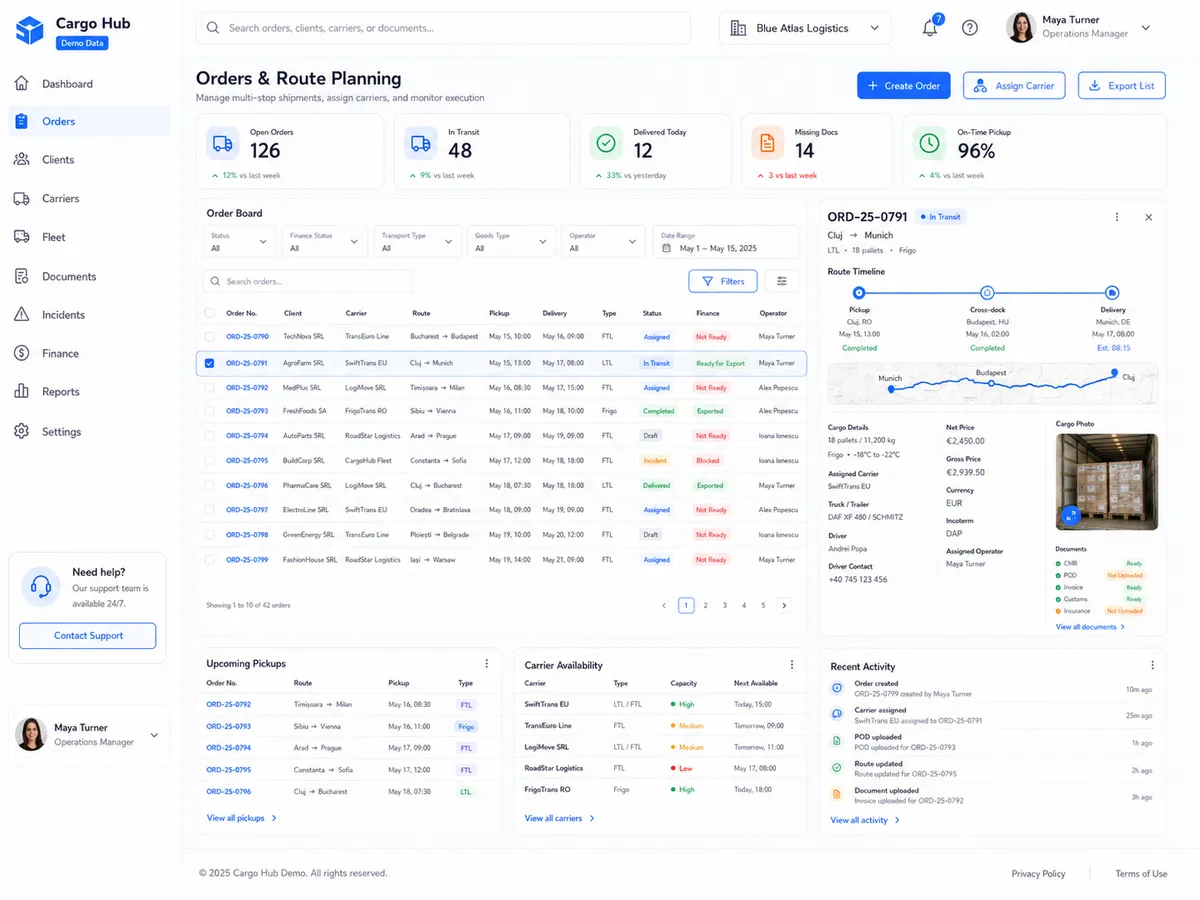
Logistics software pays off when it kills the gaps — between the order, the route, the driver, the paperwork and the invoice. Most operations don't fail on any single step; they fail in the handoffs, where things get re-typed, lost, or chased down by phone. A platform earns its keep by closing those gaps so the whole operation runs from one live screen instead of a dozen. That's exactly what we built Cargo Hub to do.
The real pain: a freight operation run on phone calls
Most delivery operations don't run on software — they run on a dispatcher, a phone, a whiteboard, and a stack of spreadsheets that disagree with each other. Where is shipment 4471? Ask the driver. Did the customer sign for it? Check the WhatsApp photo. Did we invoice it? That's a different spreadsheet, updated whenever someone remembers.
Each tool works fine alone. The pain is the space between them. Nobody can answer a simple question — "what's late today, and what does it cost us?" — without a round of phone calls. Decisions that should take a minute take an afternoon, and the truth lives in someone's head instead of on a screen.
What a logistics platform should actually do
Good freight software isn't a prettier spreadsheet. It's a single source of truth that follows a shipment from booking to paid invoice. A few things have to be in one place, live:
- Operations and dispatch — every shipment, its status, and who's carrying it, on one board instead of in someone's memory.
- Routing — route planning that turns a list of stops into a plan a driver can actually run, not a guess made at 6am.
- Carrier performance — who delivers on time and who doesn't, measured rather than remembered, so the next assignment is an informed one.
- Documents and OCR — paperwork that reads itself. Cargo Hub's OCR captures and validates the documents so the team doesn't re-type a stack of CMRs and invoices by hand.
- Finance — costs, charges and invoicing connected to the actual shipments, not reconciled from scratch at month-end.
When these share one data layer, the questions that used to need an afternoon answer themselves.
Proof-of-delivery and the live ops view
Two things separate software that helps from software that just stores. The first is proof-of-delivery that's part of the record — when a delivery is confirmed, it lands against the shipment, ready for the invoice, not buried in a phone's camera roll. The second is a live operations view: the dispatcher sees the whole day at a glance — what's moving, what's late, what's done — and acts on it, instead of reconstructing it call by call.
That live picture is the difference between running the operation and chasing it. It's the single screen the team opens in the morning and trusts all day.
Build vs buy
You can buy generic logistics software. Sometimes that's the right call — if your operation fits the mould the vendor built. The trouble is that most don't. Real operations have their own routes, their own carrier rules, their own paperwork and their own way of pricing a job. Off-the-shelf tools make you bend your process to their shape, and the gaps you were trying to close quietly reopen.
A tailored platform fits your operation instead of the other way round. We're honest about the trade-off: building costs more up front than a subscription. But when the software matches how you actually dispatch, deliver and invoice, it pays for itself in the work it stops being manual.
How Cargo Hub embodies it
Cargo Hub is the concrete version of all of the above — a freight operation run from one screen. Shipment status, route planning, carrier performance and finance sit together, and the OCR reads and validates the paperwork so the team handles exceptions instead of data entry. It wasn't bought; it was built for the way the operation actually runs.
That's the approach behind everything in our product work: scope the real pain, put it in one live place, and let the team stop stitching the picture together by hand.
If your deliveries are running on spreadsheets and phone calls, that's usually the clearest sign a platform of your own would pay off. We'd be glad to talk it through — no pitch, just an honest look at what a system built for your operation could do.